Announcements
- Assignment 1 is due tonight!
- Have a look at the clarifications on Canvas Announcements
- Please submit individually. Write up answers individually, code can be shared across team. Don't need to report who did what.
- My office hours are after class
- Project proposals will be due by the end of the month
- You should start forming teams
- Check out thread on Canvas
- We will share project ideas
- Use the anonymous Google feedback form to let us know how things are going so far
Part 1: Revisiting Generative Models
In the previous lecture, we introduced generative modeling and Naive Bayes.
We will start with a review and a motivating problem.
The Iris Flowers Dataset
As a motivating problem for this lecture, we are going to use the Iris flower dataset (R. A. Fisher, 1936).
Recall that our task is to classify subspecies of Iris flowers based on their measurements.
import numpy as np
import pandas as pd
import warnings
warnings.filterwarnings('ignore')
from sklearn import datasets

# Load the Iris dataset
iris = datasets.load_iris(as_frame=True)

# print part of the dataset
iris_X, iris_y = iris.data, iris.target
pd.concat([iris_X, iris_y], axis=1).head()
If we only consider the first two feature columns, we can visualize the dataset in 2D.
# https://scikit-learn.org/stable/auto_examples/neighbors/plot_classification.html
%matplotlib inline
from matplotlib import pyplot as plt
plt.rcParams['figure.figsize'] = [12, 4]

# create 2d version of dataset
X = iris_X.to_numpy()[:,:2]
x_min, x_max = X[:, 0].min() - .5, X[:, 0].max() + .5
y_min, y_max = X[:, 1].min() - .5, X[:, 1].max() + .5

# Plot also the training points
p1 = plt.scatter(X[:, 0], X[:, 1], c=iris_y, edgecolor='k', s=60, cmap=plt.cm.Paired)
plt.xlabel('Sepal Length (cm)')
plt.ylabel('Sepal Width (cm)')
plt.legend(handles=p1.legend_elements()[0], labels=['Setosa', 'Versicolour', 'Virginica'], loc='lower right')

Review: Discriminative Models
Most models we have seen so far have been discriminative:
- They directly transforms $x$ into a score for each class $y$ (e.g., via the formula $y=\sigma(\theta^\top x)$)
- They can be interpreted as defining a conditional probability $P_\theta(y|x)$
For example, logistic regression is a binary classification algorithm which uses a model $$f_\theta : \mathcal{X} \to [0,1]$$ of the form $$ f_\theta(x) = \sigma(\theta^\top x) = \frac{1}{1 + \exp(-\theta^\top x)}, $$ where $\sigma(z) = \frac{1}{1 + \exp(-z)}$ is the sigmoid or logistic function.
The logistic model defines ("parameterizes") a probability distribution $P_\theta(y|x) : \mathcal{X} \times \mathcal{Y} \to [0,1]$ as follows:
\begin{align*} P_\theta(y=1 | x) & = \sigma(\theta^\top x) \\ P_\theta(y=0 | x) & = 1-\sigma(\theta^\top x). \end{align*}Let's train logistic/softmax regression on this dataset.
from matplotlib import pyplot as plt
plt.rcParams['figure.figsize'] = [12, 4]
from sklearn.linear_model import LogisticRegression
logreg = LogisticRegression(C=1e5)

# Create an instance of Logistic Regression Classifier and fit the data.
X = iris_X.to_numpy()[:,:2]
# rename class two to class one
Y = iris_y.copy()
logreg.fit(X, Y)
We visualize the regions predicted to be associated with the blue, brown, and yellow classes and the lines between them are the decision boundaries.
xx, yy = np.meshgrid(np.arange(4, 8.2, .02), np.arange(1.8, 4.5, .02))
Z = logreg.predict(np.c_[xx.ravel(), yy.ravel()])

# Put the result into a color plot
Z = Z.reshape(xx.shape)
plt.pcolormesh(xx, yy, Z, cmap=plt.cm.Paired)

# Plot also the training points
plt.scatter(X[:, 0], X[:, 1], c=Y, edgecolors='k', cmap=plt.cm.Paired, s=50)
plt.xlabel('Sepal length')
plt.ylabel('Sepal width')

plt.show()

Review: Generative Models
Another approach to classification is to use generative models.
- A generative approach first builds a model of $x$ for each class: $$ P_\theta(x | y=k) \; \text{for each class $k$}.$$ $P_\theta(x | y=k)$ scores each $x$ according to how well it matches class $k$.
- A class probability $P_\theta(y=k)$ encoding our prior beliefs $$ P_\theta(y=k) \; \text{for each class $k$}.$$ These are often just the % of each class in the data.
In the context of Iris flower classification, we would fit three models on a labeled corpus:
\begin{align*} P_\theta(x|y=\text{0}) && P_\theta(x|y=\text{1}) && P_\theta(x|y=\text{2}) \end{align*}We would also define priors $P_\theta(y=\text{0}), P_\theta(y=\text{1}),P_\theta(y=\text{2})$.
$P_\theta(x | y=k)$ scores each $x$ based on how much it looks like class $k$.
Review: Bernoulli Naive Bayes Model
The Bernoulli Naive Bayes model $P_\theta(x,y)$ is defined for binary data $x \in \{0,1\}^d$ (e.g., bag-of-words documents).
The $\theta$ contains prior parameters $\vec\phi = (\phi_1,...,\phi_K)$ and $K$ sets of per-class parameters $\psi_k = (\psi_{1k},...,\phi_{dk})$.
The probability of the data $x$ for each class equals $$P_\theta(x|y=k) = \prod_{j=1}^d P(x_j \mid y=k),$$ where each $P_\theta(x_j \mid y=k)$ is a $\text{Bernoullli}(\psi_{jk})$.
The probability over $y$ is Categorical: $P_\theta(y=k) = \phi_k$.
Advantages of Naive Bayes
Naive Bayes is a very important model in machine learning.
- Usually much easier to train: we have closed form solutions for the optimal parameters!
- Can deal with missing values, noisy inputs, and more!
On many classification tasks, Naive Bayes matches the state-of-the-art.
Downsides of Naive Bayes
Fundamentally, the modeling assumptions of Naive Bayes are incorrect:
- May generate over- or under-confident predictions
- Lower performance when assumptions fail
How do we even apply Naive Bayes to the flower dataset?
$$ P(x | y=k) \text{ is undefined when $x \notin \{0,1\}^d$} $$We will look at this problem next.
Review: Categorical Distribution
A Categorical distribution with parameters $\theta$ is a probability over $K$ discrete outcomes $x \in \{1,2,...,K\}$:
$$ P_\theta(x = j) = \theta_j. $$When $K=2$ this is called the Bernoulli.
Review: Normal (Gaussian) Distribution
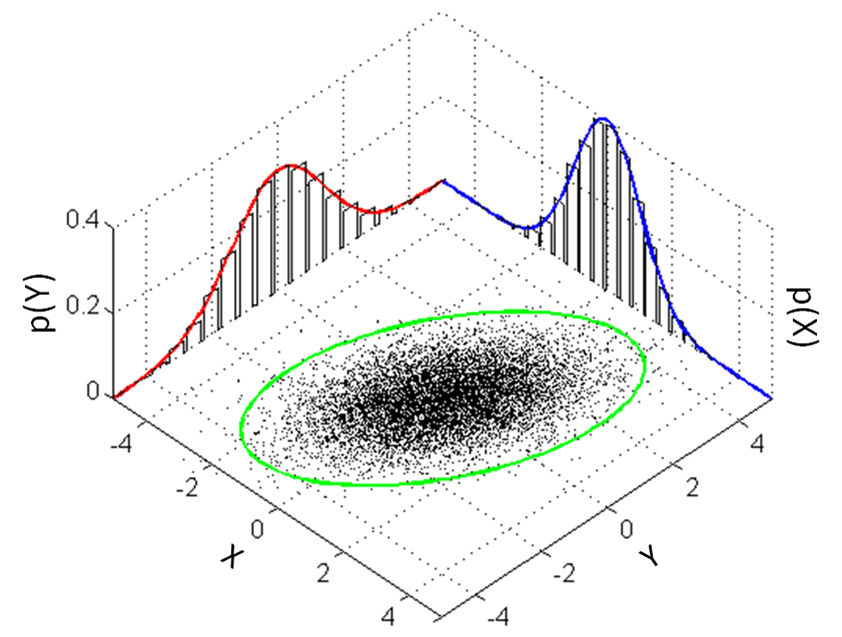
A multivariate normal distribution $P_\theta(x) : \mathcal{X} \to [0,1]$ with parameters $\theta = (\mu, \Sigma)$ is a probability over a $d$-dimensional $x \in \mathbb{R}^d$
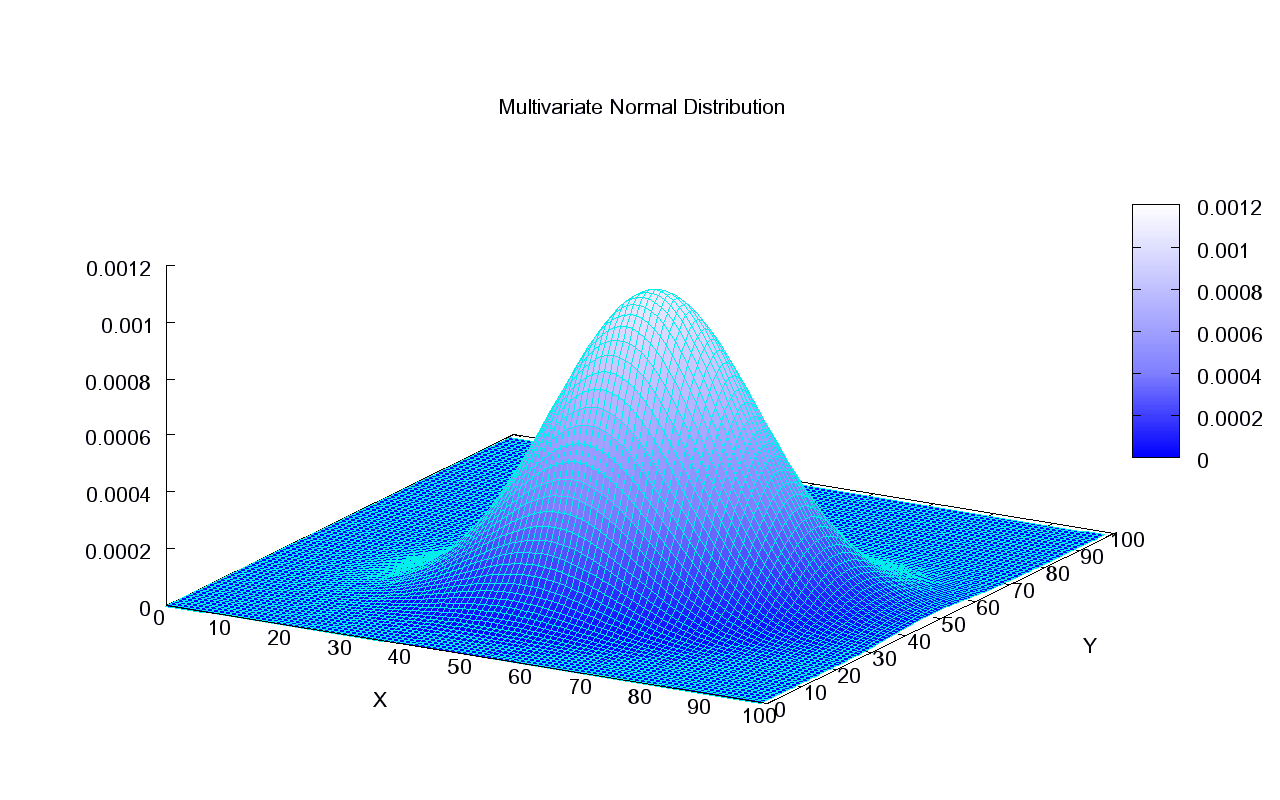
$$ P_\theta(x; \mu, \Sigma) = \frac{1}{\sqrt{(2 \pi)^d | \Sigma |}} \exp\left(-\frac{1}{2} (x - \mu)^\top \Sigma^{-1} (x-\mu) \right) $$In one dimension, this reduces to $\frac{1}{\sqrt{2 \pi}\sigma} \exp\left(-\frac{(x - \mu)^2}{2\sigma^2} \right)$.
This what the density of a Normal distribution looks like in 2D:
This is how we can visualize it in a 2D plane:
A Generative Model for Iris Flowers
To define a generative model for Iris flowers, we need to define three probabilities: \begin{align*} P_\theta(x|y=\text{0}) && P_\theta(x|y=\text{1}) && P_\theta(x|y=\text{2}) \end{align*} We also define priors $P_\theta(y=\text{0}), P_\theta(y=\text{1}), P_\theta(y=\text{2})$.
Each model $P_\theta(x | y=k)$ scores $x$ based on how much it looks like class $k$. The inputs $x$ are vectors of features for the flowers.
How do we choose $P_\theta(x|y=k)$?
Gaussian Mixture Model
A Gaussian mixture model (GMM) $P_\theta(x,y)$ is defined for real-valued data $x \in \mathbb{R}^d$.
The $\theta$ contains prior parameters $\vec\phi = (\phi_1,...,\phi_K)$ and $K$ sets of per-class Gaussian parameters $\mu_k, \Sigma_k$.
The probability of the data $x$ for each class is a multivariate Gaussian $$P_\theta(x|y=k) = \mathcal{N}(x ; \mu_k, \Sigma_k).$$
The probability over $y$ is Categorical: $P_\theta(y=k) = \phi_k$.
Why Mixtures of Distributions?
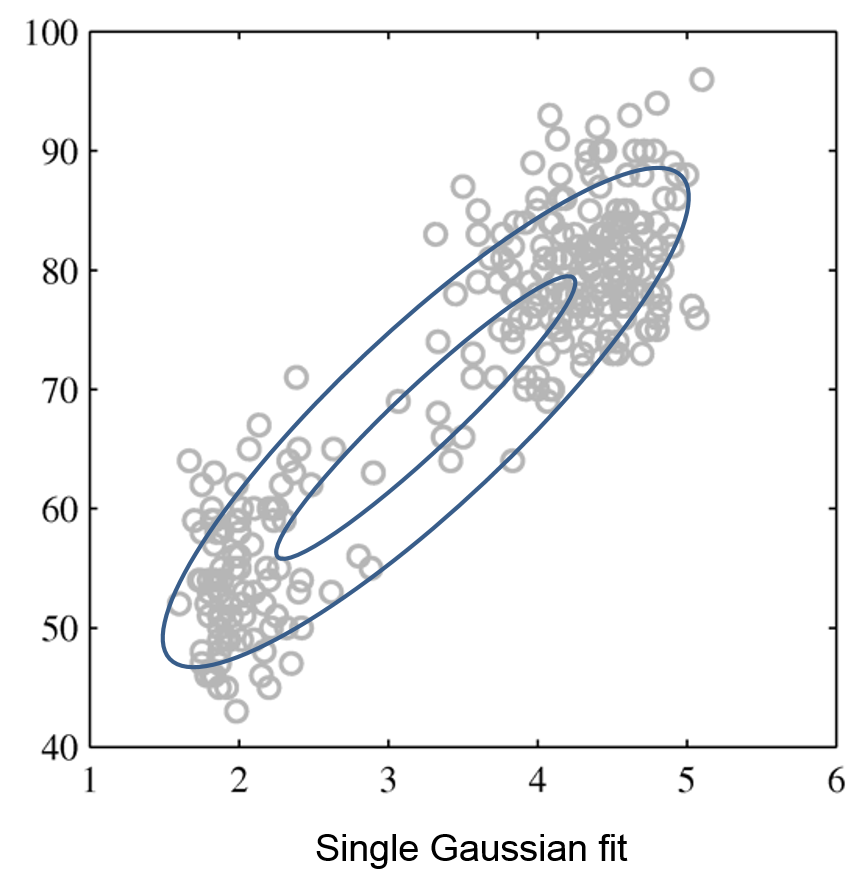
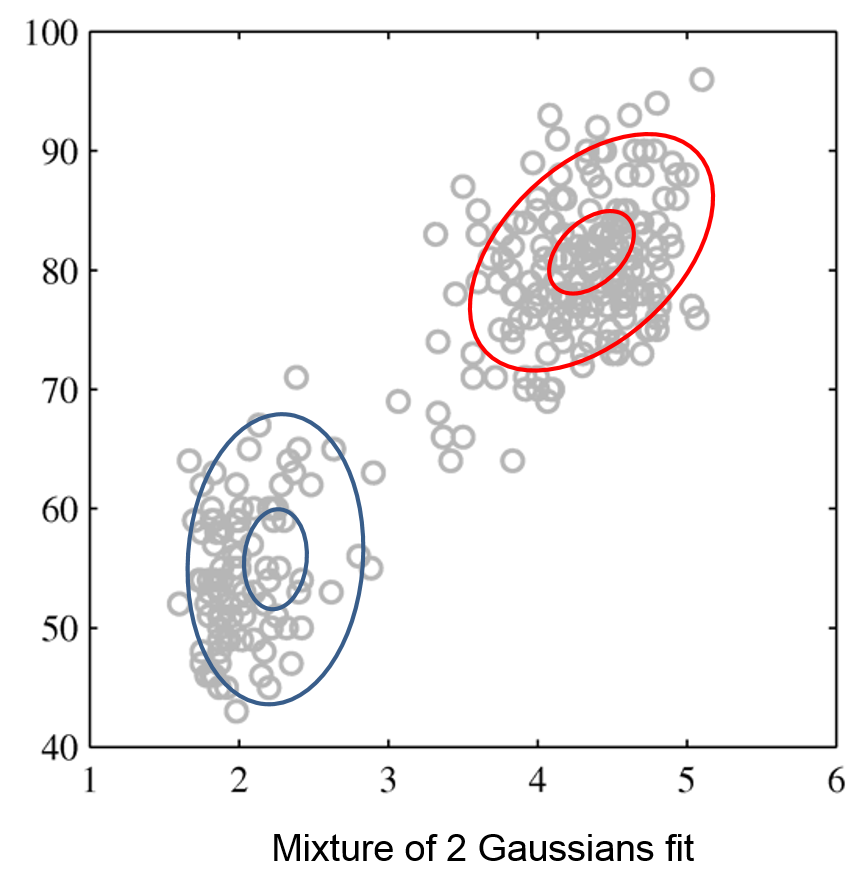
A single distribution (e.g., a Gaussian) can be too simple to fit the data. We can form more complex distributions by mixing $K$ simple ones:
$$ P_\theta(x) = \phi_1 P_1(x ;\theta_1) + \phi_2 P_2(x ;\theta_2) + \ldots + \phi_1 P_K(x ;\theta_K) $$where the $\phi_k \in [0,1]$ are the weights of each distribution.
A mixture of $K$ Gaussians is a distribution $P(x)$ of the form: $$\phi_1 \mathcal{N}(x; \mu_1, \Sigma_1) + \phi_2 \mathcal{N}(x; \mu_2, \Sigma_2) + \ldots + \phi_K \mathcal{N}(x; \mu_K, \Sigma_K).$$
Mixtures can express distributions that a single mixture component can't:
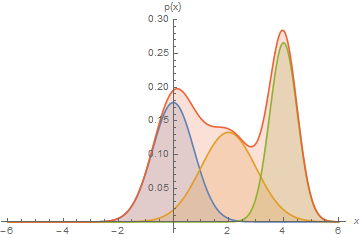
Here, we have a mixture of 3 Gaussians.
GMMs Are Indeed Mixtures
The Gaussian Mixture Model is an example of a mixture of $K$ distributions with mixing weights $\phi_k = P(y=k)$: $$P_\theta(x) = \sum_{k=1}^K P_\theta(y=k) P_\theta(x|y=k) = \sum_{k=1}^K \phi_k \mathcal{N}(x; \mu_k, \Sigma_k)$$
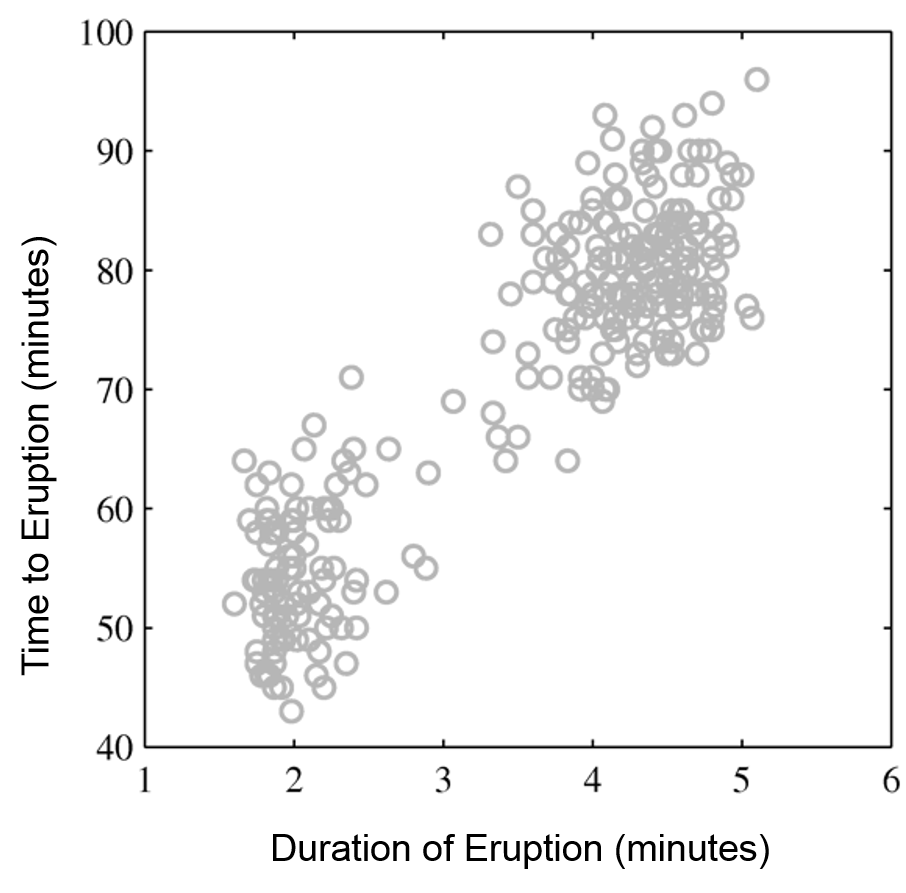
Mixtures of Gaussians fit more complex distributions than one Gaussian.
| Raw data | Single Gaussian | Mixture of Gaussians |
|---|---|---|
 |
 |
 |

Part 3: Gaussian Discriminant Analysis
Next, we will use GMMs as the basis for a new generative classification algorithm, Gaussian Discriminant Analysis (GDA).
Review: Maximum Likelihood Learning
We can learn a generative model $P_\theta(x, y)$ by maximizing the maximum likelihood:
$$ \max_\theta \frac{1}{n}\sum_{i=1}^n \log P_\theta({x}^{(i)}, y^{(i)}). $$This seeks to find parameters $\theta$ such that the model assigns high probability to the training data.
Let's use maximum likelihood to fit the Guassian Discriminant model. Note that model parameterss $\theta$ are the union of the parameters of each sub-model: $$\theta = (\mu_1, \Sigma_1, \phi_1, \ldots, \mu_K, \Sigma_K, \phi_K).$$
Optimizing the Log Likelihood
Given a dataset $\mathcal{D} = \{(x^{(i)}, y^{(i)})\mid i=1,2,\ldots,n\}$, we want to optimize the log-likelihood $\ell(\theta)$: \begin{align*} \ell(\theta) & = \sum_{i=1}^n \log P_\theta(x^{(i)}, y^{(i)}) = \sum_{i=1}^n \log P_\theta(x^{(i)} | y^{(i)}) + \sum_{i=1}^n \log P_\theta(y^{(i)}) \\ & = \sum_{k=1}^K \underbrace{\sum_{i : y^{(i)} = k} \log P(x^{(i)} | y^{(i)} ; \mu_k, \Sigma_k)}_\text{all the terms that involve $\mu_k, \Sigma_k$} + \underbrace{\sum_{i=1}^n \log P(y^{(i)} ; \vec \phi)}_\text{all the terms that involve $\vec \phi$}. \end{align*}
In equality #2, we use the fact that $P_\theta(x,y)=P_\theta(y) P_\theta(x|y)$; in the third one, we change the order of summation.
Each $\mu_k, \Sigma_k$ for $k=1,2,\ldots,K$ is found in only the following terms: \begin{align*} \max_{\mu_k, \Sigma_k} \sum_{i=1}^n \log P_\theta(x^{(i)}, y^{(i)}) & = \max_{\mu_k, \Sigma_k} \sum_{l=1}^K \sum_{i : y^{(i)} = l} \log P_\theta(x^{(i)} | y^{(i)} ; \mu_l, \Sigma_l) \\ & = \max_{\mu_k, \Sigma_k} \sum_{i : y^{(i)} = k} \log P_\theta(x^{(i)} | y^{(i)} ; \mu_k, \Sigma_k). \end{align*} Thus, optimization over $\mu_k, \Sigma_k$ can be carried out independently of all the other parameters by just looking at these terms.
Similarly, optimizing for $\vec \phi = (\phi_1, \phi_2, \ldots, \phi_K)$ only involves a few terms: $$ \max_{\vec \phi} \sum_{i=1}^n \log P_\theta(x^{(i)}, y^{(i)} ; \theta) = \max_{\vec\phi} \ \sum_{i=1}^n \log P_\theta(y^{(i)} ; \vec \phi). $$
Learning the Parameters $\phi$
Let's first consider the optimization over $\vec \phi = (\phi_1, \phi_2, \ldots, \phi_K)$. $$ \max_{\vec \phi} \sum_{i=1}^n \log P_\theta(y=y^{(i)} ; \vec \phi). $$
- We have $n$ datapoints. Each point has a label $k\in\{1,2,...,K\}$.
- Our model is a categorical and assigns a probability $\phi_k$ to each outcome $k\in\{1,2,...,K\}$.
- We want to infer $\phi_k$ assuming our dataset is sampled from the model.
What are the maximum likelihood $\phi_k$ that are most likely to have generated our data?
Inuitively, the maximum likelihood class probabilities $\phi$ should just be the class proportions that we see in the data.
Let's calculate this formally. Our objective $J(\vec \phi)$ equals \begin{align*} J(\vec\phi) & = \sum_{i=1}^n \log P_\theta(y^{(i)} ; \vec \phi) \\ & = \sum_{i=1}^n \log \phi_{y^{(i)}} - n \cdot \log \sum_{k=1}^K \phi_k \\ & = \sum_{k=1}^K \sum_{i : y^{(i)} = k} \log \phi_k - n \cdot \log \sum_{k=1}^K \phi_k \end{align*}
Taking the derivative and setting it to zero, we obtain $$ \frac{\phi_k}{\sum_l \phi_l} = \frac{n_k}{n}$$ for each $k$, where $n_k = |\{i : y^{(i)} = k\}|$ is the number of training targets with class $k$.
Thus, the optimal $\phi_k$ is just the proportion of data points with class $k$ in the training set!
Learning the Parameters $\mu_k, \Sigma_k$
Next, let's look at the maximum likelihood term $$\max_{\mu_k, \Sigma_k} \sum_{i : y^{(i)} = k} \log \mathcal{N}(x^{(i)} | \mu_k, \Sigma_k)$$ over the Gaussian parameters $\mu_k, \Sigma_k$.
- Our dataset are all the points $x$ for which $y=k$.
- We want to learn the mean and variance $\mu_k, \Sigma_k$ of a normal distribution that generates this data.
What is the maximum likelihood $\mu_k, \Sigma_k$ in this case?
Computing the derivative and setting it to zero, we obtain closed form solutions: \begin{align*} \mu_k & = \frac{\sum_{i: y^{(i)} = k} x^{(i)}}{n_k} \\ \Sigma_k & = \frac{\sum_{i: y^{(i)} = k} (x^{(i)} - \mu_k)(x^{(i)} - \mu_k)^\top}{n_k} \\ \end{align*} These are just the empirical means and covariances of each class.
Querying the Model
How do we ask the model for predictions? As discussed earler, we can apply Bayes' rule: $$\arg\max_y P_\theta(y|x) = \arg\max_y P_\theta(x|y)P(y).$$ Thus, we can estimate the probability of $x$ and under each $P_\theta(x|y=k)P(y=k)$ and choose the class that explains the data best.
Algorithm: Gaussian Discriminant Analysis (GDA)
- Type: Supervised learning (multi-class classification)
- Model family: Mixtures of Gaussians.
- Objective function: Log-likelihood.
- Optimizer: Closed form solution.
Example: Iris Flower Classification
Let's see how this approach can be used in practice on the Iris dataset.
- We will learn the maximum likelihood GDA parameters
- We will compare the outputs to the true predictions.
Let's first start by computing the true parameters on our dataset.
# we can implement these formulas over the Iris dataset
d = 2 # number of features in our toy dataset
K = 3 # number of clases
n = X.shape[0] # size of the dataset

# these are the shapes of the parameters
mus = np.zeros([K,d])
Sigmas = np.zeros([K,d,d])
phis = np.zeros([K])

# we now compute the parameters
for k in range(3):
    X_k = X[iris_y == k]
    mus[k] = np.mean(X_k, axis=0)
    Sigmas[k] = np.cov(X_k.T)
    phis[k] = X_k.shape[0] / float(n)

# print out the means
print(mus)
We can compute predictions using Bayes' rule.
# we can implement this in numpy
def gda_predictions(x, mus, Sigmas, phis):
    """This returns class assignments and p(y|x) under the GDA model.

    We compute \arg\max_y p(y|x) as \arg\max_y p(x|y)p(y)
    """
    # adjust shapes
    n, d = x.shape
    x = np.reshape(x, (1, n, d, 1))
    mus = np.reshape(mus, (K, 1, d, 1))
    Sigmas = np.reshape(Sigmas, (K, 1, d, d))

    # compute probabilities
    py = np.tile(phis.reshape((K,1)), (1,n)).reshape([K,n,1,1])
    pxy = (
        np.sqrt(np.abs((2*np.pi)**d*np.linalg.det(Sigmas))).reshape((K,1,1,1))
        * -.5*np.exp(
            np.matmul(np.matmul((x-mus).transpose([0,1,3,2]), np.linalg.inv(Sigmas)), x-mus)
        )
    )
    pyx = pxy * py
    return pyx.argmax(axis=0).flatten(), pyx.reshape([K,n])

idx, pyx = gda_predictions(X, mus, Sigmas, phis)
print(idx)
We visualize the decision boundaries like we did earlier.
from matplotlib.colors import LogNorm
xx, yy = np.meshgrid(np.arange(x_min, x_max, .02), np.arange(y_min, y_max, .02))
Z, pyx = gda_predictions(np.c_[xx.ravel(), yy.ravel()], mus, Sigmas, phis)
logpy = np.log(-1./3*pyx)

# Put the result into a color plot
Z = Z.reshape(xx.shape)
contours = np.zeros([K, xx.shape[0], xx.shape[1]])
for k in range(K):
    contours[k] = logpy[k].reshape(xx.shape)
plt.pcolormesh(xx, yy, Z, cmap=plt.cm.Paired)
for k in range(K):
    plt.contour(xx, yy, contours[k], levels=np.logspace(0, 1, 1))

# Plot also the training points
plt.scatter(X[:, 0], X[:, 1], c=iris_y, edgecolors='k', cmap=plt.cm.Paired)
plt.xlabel('Sepal length')
plt.ylabel('Sepal width')

plt.show()

Special Cases of GDA
Many important generative algorithms are special cases of Gaussian Discriminative Analysis
- Linear discriminant analysis (LDA): all the covariance matrices $\Sigma_k$ take the same value.
- Gaussian Naive Bayes: all the covariance matrices $\Sigma_k$ are diagonal.
- Quadratic discriminant analysis (QDA): another term for GDA.
Part 4: Discriminative vs. Generative Algorithms
We conclude our lectures on generative algorithms by revisting the question of how they compare to discriminative algorithms.
Linear Discriminant Analysis
When the covariances $\Sigma_k$ in GDA are equal, we have an algorithm called Linear Discriminant Analysis or LDA.
The probability of the data $x$ for each class is a multivariate Gaussian with the same covariance $\Sigma$. $$P_\theta(x|y=k) = \mathcal{N}(x ; \mu_k, \Sigma).$$
The probability over $y$ is Categorical: $P_\theta(y=k) = \phi_k$.
Let's try this algorithm on the Iris flower dataset.
We compute the model parameters similarly to how we did for GDA.
# we can implement these formulas over the Iris dataset
d = 2 # number of features in our toy dataset
K = 3 # number of clases
n = X.shape[0] # size of the dataset

# these are the shapes of the parameters
mus = np.zeros([K,d])
Sigmas = np.zeros([K,d,d])
phis = np.zeros([K])

# we now compute the parameters
for k in range(3):
    X_k = X[iris_y == k]
    mus[k] = np.mean(X_k, axis=0)
    Sigmas[k] = np.cov(X.T) # this is now X.T instead of X_k.T
    phis[k] = X_k.shape[0] / float(n)

# print out the means
print(mus)
We can compute predictions using Bayes' rule.
# we can implement this in numpy
def gda_predictions(x, mus, Sigmas, phis):
    """This returns class assignments and p(y|x) under the GDA model.

    We compute \arg\max_y p(y|x) as \arg\max_y p(x|y)p(y)
    """
    # adjust shapes
    n, d = x.shape
    x = np.reshape(x, (1, n, d, 1))
    mus = np.reshape(mus, (K, 1, d, 1))
    Sigmas = np.reshape(Sigmas, (K, 1, d, d))

    # compute probabilities
    py = np.tile(phis.reshape((K,1)), (1,n)).reshape([K,n,1,1])
    pxy = (
        np.sqrt(np.abs((2*np.pi)**d*np.linalg.det(Sigmas))).reshape((K,1,1,1))
        * -.5*np.exp(
            np.matmul(np.matmul((x-mus).transpose([0,1,3,2]), np.linalg.inv(Sigmas)), x-mus)
        )
    )
    pyx = pxy * py
    return pyx.argmax(axis=0).flatten(), pyx.reshape([K,n])

idx, pyx = gda_predictions(X, mus, Sigmas, phis)
print(idx)
We visualize predictions like we did earlier.
from matplotlib.colors import LogNorm
xx, yy = np.meshgrid(np.arange(x_min, x_max, .02), np.arange(y_min, y_max, .02))
Z, pyx = gda_predictions(np.c_[xx.ravel(), yy.ravel()], mus, Sigmas, phis)
logpy = np.log(-1./3*pyx)

# Put the result into a color plot
Z = Z.reshape(xx.shape)
contours = np.zeros([K, xx.shape[0], xx.shape[1]])
for k in range(K):
    contours[k] = logpy[k].reshape(xx.shape)
plt.pcolormesh(xx, yy, Z, cmap=plt.cm.Paired)

# Plot also the training points
plt.scatter(X[:, 0], X[:, 1], c=iris_y, edgecolors='k', cmap=plt.cm.Paired)
plt.xlabel('Sepal length')
plt.ylabel('Sepal width')

plt.show()

Linear Discriminant Analysis outputs decision boundaries that are linear, just like Logistic/Softmax Regression.
What Is the LDA Model Class?
We can derive a formula for $P_\theta(y|x)$ in a Bernoulli Naive Bayes or LDA model when $K=2$: $$ P_\theta(y|x) = \frac{P_\theta(x|y)P_\theta(y)}{\sum_{y'\in \mathcal{Y}}P_\theta(x|y')P_\theta(y')} = \frac{1}{1+\exp(-\gamma^\top x)} $$ for some set of parameters $\gamma$ (whose expression can be derived from $\theta$).
This is the same form as Logistic Regression! Does it mean that the two sets of algorithms are equivalent?
No! They assume the same model class $\mathcal{M}$, they use a different objective $J$ to select a model in $\mathcal{M}$.
LDA vs. Logistic Regression
What are the differences between LDA/NB and logistic regession?
- Bernoulli Naive Bayes or LDA assumes a logistic form for $P(y|x)$. But the converse is not true: logistic regression does not assume a NB or LDA model for $P(x,y)$.
- Generative models make stronger modeling assumptions. If these assumptions hold true, the generative models will perform better.
- But if they don't, logistic regression will be more robust to outliers and model misspecification, and achieve higher accuracy.
Discriminative Approaches
Discriminative algorithms are deservingly very popular.
- Most state-of-the-art algorithms for classification are discriminative (including neural nets, boosting, SVMs, etc.)
- They are often more accurate because they make fewer modeling assumptions.
Other Useful Features of Generative Models
Generative models can also do things that discriminative models can't do.
- Generation: we can sample $x \sim p(x|y)$ to generate new data (images, audio).
- Missing value imputation: if $x_j$ is missing, we infer it using $p(x|y)$.
- Outlier detection: we may detect via $p(x')$ if $x'$ is an outlier.
- Scalability: Simple formulas for maximum likelihood parameters.